IBC Tote Size Guide & Specifications
Everything you need to know about IBC tote dimensions, capacities, grades, and materials. Find the right container for your specific application.
Get a Free Quote
We respond within 24 hours
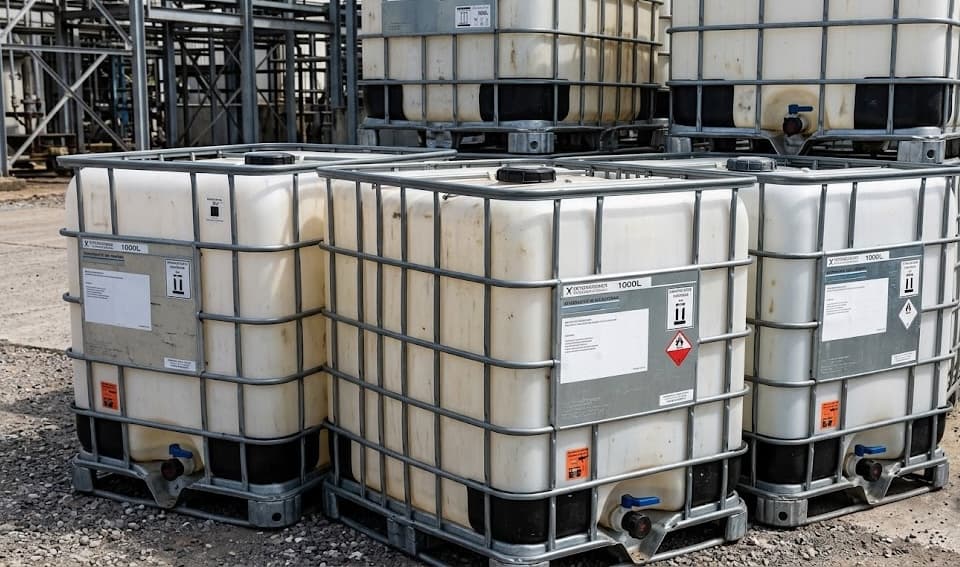
IBC Tote Size Guide
IBC Tote Size Comparison
IBC totes (Intermediate Bulk Containers) are manufactured in five standard sizes. The 275-gallon and 330-gallon variants account for over 90% of the market and are the sizes we stock most frequently at our Elk Grove Village facility.
| Size | Metric | L x W x H (in) | L x W x H (cm) | Empty Weight | Full Weight (Water) | Pallet | Availability |
|---|---|---|---|---|---|---|---|
| 120 Gallon | 454 L | 36" x 36" x 38" | 91 x 91 x 97 | 80 lbs | 1,080 lbs | 36" x 36" Steel | Limited |
| 180 Gallon | 681 L | 40" x 40" x 42" | 102 x 102 x 107 | 95 lbs | 1,595 lbs | 40" x 40" Wood/Steel | Moderate |
| 275 Gallon | 1,040 L | 48" x 40" x 46" | 122 x 102 x 117 | 120 lbs | 2,415 lbs | 48" x 40" Wood/Composite | High - Most Common |
| 330 Gallon | 1,249 L | 48" x 40" x 53" | 122 x 102 x 135 | 135 lbs | 2,885 lbs | 48" x 40" Wood/Composite | High |
| 550 Gallon | 2,082 L | 48" x 48" x 67" | 122 x 122 x 170 | 200 lbs | 4,790 lbs | 48" x 48" Heavy-Duty Steel | Specialty Order |
Common Uses by Size
| Size | Common Applications |
|---|---|
| 120 Gallon | Lab chemicals, pharmaceutical intermediates, small-batch flavoring, specialty solvents |
| 180 Gallon | Cosmetics, concentrated cleaners, adhesive components, mid-volume chemical storage |
| 275 Gallon | Food ingredients, agricultural chemicals, water storage, industrial solvents, general manufacturing |
| 330 Gallon | High-volume liquids, beverages, fuel additives, bulk water, agricultural irrigation |
| 550 Gallon | Bulk chemical transport, large-scale water treatment, industrial resins, waste collection |
275 Gallon IBC Tote - Detailed Specifications
The 275-gallon IBC tote is the industry standard and the most widely used intermediate bulk container in North America. It fits a standard 48" x 40" pallet footprint and is compatible with most forklifts, pallet jacks, and warehouse racking systems.
Dimensions & Capacity
| Volume | 275 US gallons (1,040 liters) |
| Overall Length | 48 inches (122 cm) |
| Overall Width | 40 inches (102 cm) |
| Overall Height (with pallet) | 46 inches (117 cm) |
| Bottle Height (without pallet) | 40 inches (102 cm) |
| Inner Diameter (opening) | 6 inches (150 mm) standard |
| Fill Opening | 6" threaded cap (standard) or 8" dust cap |
| Discharge Valve | 2" (50 mm) butterfly or ball valve |
| Valve Height from Ground | 3 inches (76 mm) |
| Wall Thickness | 2.0-3.5 mm (varies by manufacturer) |
Weight & Load Specifications
| Empty Weight (tote + pallet) | ~120 lbs (54 kg) |
| Bottle Weight (empty) | ~48 lbs (22 kg) |
| Cage Weight | ~46 lbs (21 kg) |
| Pallet Weight | ~26 lbs (12 kg) |
| Maximum Fill Weight (water) | ~2,295 lbs (1,041 kg) |
| Gross Weight (full) | ~2,415 lbs (1,095 kg) |
| Max Specific Gravity | 1.9 (for heavier-than-water liquids) |
| Stacking Load (static) | Up to 4,630 lbs per level |
| Max Stack Height | 2 high when full, 4 high when empty |
| Operating Temperature | -40 F to 140 F (-40 C to 60 C) |
Compliance & Certifications
- ✓UN/DOT Rated: UN31HA1/Y for transport of hazardous goods (when manufacturer-certified)
- ✓FDA Compliant: Grade A bottles use FDA-approved HDPE resins suitable for food contact
- ✓ISO 9001: Major manufacturers produce under ISO 9001 quality management systems
- ✓ISPM-15: Wood pallets heat-treated per international phytosanitary standards
- ✓NFPA Compliant: Does not generate toxic fumes under normal storage conditions
Best Applications for 275 Gallon
- ●Food & Beverage: Liquid ingredients, syrups, concentrates, oils, vinegar, and juice (Grade A only)
- ●Agriculture: Fertilizers, pesticides, herbicides, animal feed supplements, and irrigation water
- ●Chemical Manufacturing: Solvents, cleaning agents, industrial lubricants, and processing chemicals
- ●Water Storage: Emergency water reserves, rainwater harvesting, construction site water supply
- ●General Industrial: Waste collection, coolant storage, parts washing, bulk material handling
330 Gallon IBC Tote - Detailed Specifications
The 330-gallon IBC tote shares the same 48" x 40" footprint as the 275-gallon model but stands 7 inches taller, providing 20% more capacity without taking up additional floor space. This makes it ideal for operations that need maximum volume per pallet position.
Dimensions & Capacity
| Volume | 330 US gallons (1,249 liters) |
| Overall Length | 48 inches (122 cm) |
| Overall Width | 40 inches (102 cm) |
| Overall Height (with pallet) | 53 inches (135 cm) |
| Bottle Height (without pallet) | 47 inches (119 cm) |
| Inner Diameter (opening) | 6 inches (150 mm) standard |
| Fill Opening | 6" threaded cap (standard) or 8" dust cap |
| Discharge Valve | 2" (50 mm) butterfly or ball valve |
| Valve Height from Ground | 3 inches (76 mm) |
| Wall Thickness | 2.5-4.0 mm (heavier duty than 275) |
Weight & Load Specifications
| Empty Weight (tote + pallet) | ~135 lbs (61 kg) |
| Bottle Weight (empty) | ~55 lbs (25 kg) |
| Cage Weight | ~52 lbs (24 kg) |
| Pallet Weight | ~28 lbs (13 kg) |
| Maximum Fill Weight (water) | ~2,750 lbs (1,247 kg) |
| Gross Weight (full) | ~2,885 lbs (1,309 kg) |
| Max Specific Gravity | 1.7 (due to taller profile) |
| Stacking Load (static) | Up to 4,400 lbs per level |
| Max Stack Height | 2 high when full, 3 high when empty |
| Operating Temperature | -40 F to 140 F (-40 C to 60 C) |
275 vs 330 Gallon - Side by Side
| Specification | 275 Gallon | 330 Gallon | Difference |
|---|---|---|---|
| Capacity | 275 gal (1,040 L) | 330 gal (1,249 L) | +55 gal (+20%) |
| Height | 46 in (117 cm) | 53 in (135 cm) | +7 in (+15%) |
| Footprint | 48" x 40" | 48" x 40" | Same |
| Empty Weight | ~120 lbs | ~135 lbs | +15 lbs |
| Full Weight | ~2,415 lbs | ~2,885 lbs | +470 lbs |
| Max Stack (full) | 2 high | 2 high | Same |
| Max Stack (empty) | 4 high | 3 high | -1 level |
| Warehouse Fit | Standard racking | Check clearance | Verify height |
| Price (used) | Lower | Slightly higher | ~10-15% more |
| Availability | Most common | Common | Both readily available |
IBC Tote Grade Comparison
Used IBC totes are classified into three grades based on their cosmetic condition, structural integrity, and previous contents. Understanding grades is critical to selecting the right container for your application and budget.
Grade A (Like-New / Food-Grade Ready)
| Overall Appearance | Clean white or translucent bottle with no staining, yellowing, or discoloration. Cage is straight and fully intact. Labels may have been removed. |
| Bottle Condition | No scratches deeper than surface level. No warping, bulging, or UV damage. Walls are uniformly thick with no thin spots. |
| Cage Condition | All welds intact. No bent bars, no rust, no missing components. Cage fits snugly around the bottle with no gaps. |
| Valve Condition | Original butterfly or ball valve in full working condition. No leaks, no stiffness, clean threading. |
| Pallet Condition | Structurally sound with no cracks, splits, or rot. All boards present. Can bear full load without flexing. |
| Previous Contents | Food-grade liquids, purified water, cosmetic ingredients, pharmaceutical-grade chemicals only. |
| Ideal Applications | Food and beverage production, pharmaceutical manufacturing, potable water storage, cosmetics, any application requiring FDA compliance. |
| Price Range | $$$ - Premium |
Grade B (Good Condition / Industrial-Grade)
| Overall Appearance | Bottle may show light discoloration, minor staining, or slight yellowing. Cage may have minor surface rust that does not affect structural integrity. |
| Bottle Condition | May have light surface scratches or minor scuffs. No cracks, holes, or structural damage. Slight warping acceptable if it does not affect capacity or stability. |
| Cage Condition | Structurally sound with all welds holding. Minor surface rust or cosmetic blemishes acceptable. No bent bars that affect bottle removal or replacement. |
| Valve Condition | Fully functional valve. May show minor wear or staining. No leaks under normal operating pressure. |
| Pallet Condition | Functional and load-bearing. May show wear, minor nicks, or cosmetic damage. No structural failures. |
| Previous Contents | Non-hazardous industrial chemicals, soaps, detergents, lubricants, agricultural products. |
| Ideal Applications | General industrial storage, agricultural chemicals, non-food manufacturing, water collection (non-potable), cleaning solutions. |
| Price Range | $$ - Mid-Range |
Grade C (Fair Condition / Utility-Grade)
| Overall Appearance | Noticeable staining, discoloration, or residue marks. Cage may show moderate rust or cosmetic damage. Clearly a used container. |
| Bottle Condition | Visible wear including scratches, scuffs, or staining. May have minor exterior damage that does not compromise liquid containment. Not recommended for clear liquids. |
| Cage Condition | Functional but shows significant wear. May have surface rust, minor bends, or repaired welds. Still provides structural support. |
| Valve Condition | Functional but may require replacement for critical applications. May show significant wear or stiffness. |
| Pallet Condition | May show significant wear, repairs, or replaced boards. Functional for storage but may not meet transport standards. |
| Previous Contents | Various industrial products. May have contained dyes, inks, or products that leave residual staining. |
| Ideal Applications | Non-critical storage, rainwater collection, construction sites, waste collection, decorative planters, DIY projects, temporary containment. |
| Price Range | $ - Economy |
How to Measure an IBC Tote
Accurate measurements ensure you order the right size, fit your racking system, and comply with shipping regulations. Here is how to measure each critical dimension.
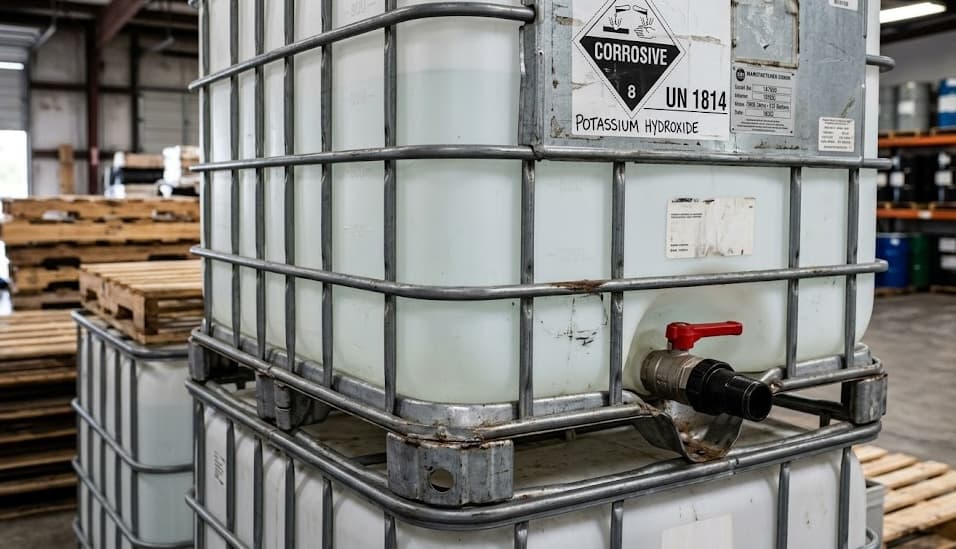
IBC tote valve and labeling detail
Overall Length
Measure the longest side of the pallet from outer edge to outer edge. For standard IBC totes, this is the 48-inch side. Place your tape measure on the ground and run it along the full length of the pallet.
Pro tip: If the pallet overhangs the cage slightly, measure the pallet, not the cage.
Overall Width
Measure the shorter side of the pallet from outer edge to outer edge. For standard IBC totes, this is the 40-inch side. Ensure the tape measure is perpendicular to the length measurement.
Pro tip: The cage and bottle should sit within the pallet footprint. If they overhang, the tote may be damaged.
Overall Height
Measure from the bottom of the pallet to the top of the fill cap. Include the pallet thickness (typically 5-6 inches). This is the dimension that matters most for warehouse racking and truck loading.
Pro tip: The fill cap adds 2-3 inches. Measure to the highest point including the cap handle.
Bottle Capacity
Check the manufacturer label on the cage or bottle for the rated capacity (in gallons or liters). If the label is missing, measure the internal dimensions and calculate: Length x Width x Height (in inches) / 231 = gallons.
Pro tip: Never rely on external dimensions alone. Wall thickness varies between 2-4 mm and affects actual capacity.
Valve Size
Measure the outer diameter of the valve threading. Standard IBC valves are 2 inches (50 mm) with either S60x6 or NPS 2" threading. Use calipers for precision or thread a known adapter onto the valve.
Pro tip: The most common valve types are butterfly (cam-lever) and ball valve. Note the type when ordering replacements.
Fill Opening
Measure the inner diameter of the top opening. Standard openings are 6 inches (150 mm) with coarse threading for a screw-on cap. Some totes have 8-inch openings with dust caps instead.
Pro tip: If you need to add mixers, heaters, or pumps through the top, verify the opening diameter before purchasing.
Choosing the Right IBC Tote Size
Selecting the correct IBC tote size depends on several factors including your volume requirements, storage constraints, transportation needs, and the product being contained. Here is a framework to help you decide.
Volume Requirements
Small batches (under 150 gallons): A 120 or 180 gallon IBC may work, but consider whether standard drums (55 gallons) would be more cost-effective and easier to handle. IBC totes shine at higher volumes.
Standard operations (150-275 gallons): The 275-gallon IBC tote is your best option. It is the most widely available, most affordable, and compatible with the widest range of equipment and infrastructure.
High-volume needs (275-330 gallons): Choose the 330-gallon if you regularly max out a 275 or want to reduce the number of containers in your operation. The identical footprint means no changes to your racking or floor plan.
Bulk storage (over 330 gallons): Consider 550-gallon totes or multiple standard units. The 550 requires special handling equipment and verification that your floors and racking can support the weight.
Space & Infrastructure
Warehouse ceiling height: Standard warehouse racking beams are set at 48-54 inches for the first level. A 275-gallon tote (46 inches) fits under most configurations. A 330-gallon tote (53 inches) may require adjusting your beam heights.
Truck loading: Standard dry van trailers have 108-inch inside widths. Two standard IBC totes fit side by side (40 + 40 = 80 inches). A 53-foot trailer can hold 20 standard IBC totes (2 wide x 10 deep).
Doorway clearance: Standard commercial doorways are 80-84 inches high. IBC totes on a forklift need 60-70 inches of clearance depending on lift height. Verify your door and aisle dimensions.
Floor load capacity: A full 275-gallon tote exerts approximately 31 PSI on the floor through its pallet. A full 330-gallon tote exerts approximately 37 PSI. Verify your floor rating, especially in upper building levels.
Quick Decision Matrix
| Your Situation | Recommended Size | Recommended Grade |
|---|---|---|
| Food/beverage production | 275 Gallon | Grade A (food-grade only) |
| General manufacturing | 275 Gallon | Grade A or B |
| Agricultural chemicals | 275 or 330 Gallon | Grade B |
| Water storage (potable) | 275 Gallon | Grade A (new bottle preferred) |
| Rainwater collection | 275 or 330 Gallon | Grade B or C |
| High-volume liquid transport | 330 Gallon | Grade A or B |
| Construction site use | 275 Gallon | Grade C |
| Waste/recycling collection | 275 or 330 Gallon | Grade C |
| DIY/garden projects | 275 Gallon | Grade C |
| Bulk chemical storage | 330 or 550 Gallon | Grade B |
Weight Capacity & Stacking Guidelines
Proper stacking and weight management are essential for safety, regulatory compliance, and preserving the life of your IBC totes. Exceeding weight limits or stacking improperly can lead to structural failure, spills, and serious injury.
Static Stacking Rules
- 1Full 275-gallon totes: Stack a maximum of 2 high. The lower tote's cage and pallet must be structurally sound with no bent bars, cracked welds, or damaged pallet boards. Total stack height approximately 92 inches.
- 2Full 330-gallon totes: Stack a maximum of 2 high. Due to the taller profile, verify ceiling clearance. Total stack height approximately 106 inches. Some warehouses may not accommodate this.
- 3Empty 275-gallon totes: Stack up to 4 high. Ensure cages are properly nested and pallets are aligned. Secure with strapping or banding to prevent shifting.
- 4Empty 330-gallon totes: Stack up to 3 high. The increased height per unit means 3 empties already reach approximately 159 inches.
Critical Safety Rules
- ⚠Never stack a full tote on an empty one. Empty totes cannot support the weight and will collapse, potentially causing catastrophic spills and injuries.
- ⚠Never stack different sizes. Mismatched footprints or heights create unstable stacks that can topple during storage or transport.
- ⚠Inspect before stacking. Check the bottom tote's cage for bent bars, cracked welds, and rust that could affect load-bearing capacity. Check the pallet for split or missing boards.
- ⚠Align precisely. The upper tote's pallet must sit squarely on the lower tote's cage frame. Even a 2-inch offset concentrates load on fewer contact points.
- ⚠Consider specific gravity. Liquids heavier than water (SG > 1.0) increase the total weight. A 275-gallon tote of a product with SG 1.5 weighs approximately 3,560 lbs -- well over the stacking limit of many pallets.
Weight Capacity by Specific Gravity
| Product Type | Specific Gravity | 275 Gal Full Weight | 330 Gal Full Weight | Stackable? |
|---|---|---|---|---|
| Vegetable oil | 0.92 | ~2,233 lbs | ~2,665 lbs | Yes (2 high) |
| Water | 1.00 | ~2,415 lbs | ~2,885 lbs | Yes (2 high) |
| Corn syrup (light) | 1.33 | ~3,175 lbs | ~3,796 lbs | Verify pallet rating |
| Sulfuric acid (dilute) | 1.40 | ~3,333 lbs | ~3,985 lbs | Not recommended |
| Glycerin | 1.26 | ~3,014 lbs | ~3,604 lbs | Verify pallet rating |
| Caustic soda (50%) | 1.53 | ~3,631 lbs | ~4,342 lbs | Not recommended |
Pallet Compatibility
The pallet is a critical component of every IBC tote. It affects forklift access, stacking capacity, durability, and compatibility with your existing warehouse infrastructure.
| Pallet Type | Material | Dimensions | Forklift Entry | Load Rating | Best For |
|---|---|---|---|---|---|
| Wood Pallet | Hardwood (heat-treated) | 48" x 40" x 5.5" | 4-way entry | ~5,000 lbs | Standard use, cost-effective, widely available |
| Composite Pallet | HDPE / recycled plastic | 48" x 40" x 6" | 4-way entry | ~5,500 lbs | Chemical resistance, clean environments, export shipping |
| Steel Pallet | Galvanized steel | 48" x 40" x 5" | 4-way entry | ~7,500 lbs | Heavy loads, outdoor exposure, maximum durability |
| Hybrid Pallet | Steel frame + wood deck | 48" x 40" x 5.5" | 4-way entry | ~6,000 lbs | Balance of cost and durability, frequent handling |
Pallet Jack Compatibility
All standard IBC pallets offer 4-way forklift entry and are compatible with standard pallet jacks (27-inch fork width). Manual pallet jacks can handle up to 5,500 lbs, which covers most filled 275-gallon totes. For full 330-gallon totes, an electric pallet jack or forklift is recommended due to the higher gross weight.
Racking Compatibility
Standard IBC totes with 48" x 40" pallets are compatible with most selective pallet racking systems designed for GMA pallets. Verify your beam spacing (minimum 42 inches clear between uprights), beam capacity (must support full tote weight plus safety factor), and height clearance (46 inches for 275 gal, 53 inches for 330 gal, plus 4-6 inches clearance).
International Shipping
For international export, wood pallets must be ISPM-15 heat-treated and stamped. Composite (plastic) pallets avoid ISPM-15 requirements entirely and are preferred for international shipments. Steel pallets are also exempt from phytosanitary regulations but add weight. Verify import country requirements before shipping.
Material Specifications
Understanding the materials in your IBC tote helps you assess chemical compatibility, temperature limits, and expected service life. An IBC tote is built from three primary components: the HDPE bottle, the steel cage, and the pallet.
HDPE Bottle Properties
| Material | High-Density Polyethylene (HDPE) -- Resin Code #2 |
| Density | 0.941-0.965 g/cm3 |
| Melting Point | 266 F (130 C) |
| Max Service Temperature | 140 F (60 C) continuous |
| Min Service Temperature | -40 F (-40 C) |
| UV Resistance | Moderate -- UV stabilizers added in quality bottles |
| Chemical Resistance | Excellent for acids, bases, alcohols, and most organic solvents |
| Chemical Sensitivity | Poor resistance to strong oxidizers, aromatic hydrocarbons (benzene, toluene) |
| FDA Status | FDA 21 CFR 177.1520 compliant when manufactured from virgin resin |
| Expected Lifespan | 5-10 years depending on UV exposure and chemical contents |
| Recyclability | Fully recyclable (resin code 2) -- accepted by most municipal and industrial recyclers |
| Wall Thickness | 2.0-4.0 mm depending on capacity and manufacturer |
| Color | Natural white/translucent (standard) or black (UV-resistant) |
Steel Cage Specifications
| Material | Carbon steel tube, galvanized or zinc-plated |
| Tube Diameter | 20-25 mm (0.8-1.0 inch) round or square |
| Wall Thickness | 1.5-2.0 mm tube wall |
| Finish | Hot-dip galvanized (premium) or electro-galvanized (standard) |
| Weld Type | MIG or resistance welds at all intersections |
| Corrosion Resistance | Good -- galvanized coating prevents rust for 10-20 years in dry conditions |
| Load Rating | 4,400-4,630 lbs top-load static (varies by manufacturer) |
| Recyclability | 100% recyclable as scrap steel |
Valve Specifications
| Standard Size | 2 inch (50 mm) NPS or S60x6 thread |
| Butterfly Valve | Polypropylene body, EPDM gasket, stainless steel lever |
| Ball Valve | Polypropylene body, PTFE seals, full-bore opening |
| Pressure Rating | 10 PSI maximum (gravity discharge) |
| Temperature Range | -4 F to 140 F (-20 C to 60 C) |
| Gasket Material | EPDM (standard), Viton (chemical-resistant option) |
Need Help Choosing the Right IBC Tote?
Our team at IBC Recycling Chicago has inspected, graded, and sold thousands of IBC totes. We can help you find the exact size, grade, and configuration for your application. Contact us for personalized recommendations.