275 Gallon IBC Tote
The industry-standard intermediate bulk container. Compact enough for tight warehouse aisles, large enough for serious liquid storage, and compatible with every standard pallet system in North America.
Get a Free Quote
We respond within 24 hours
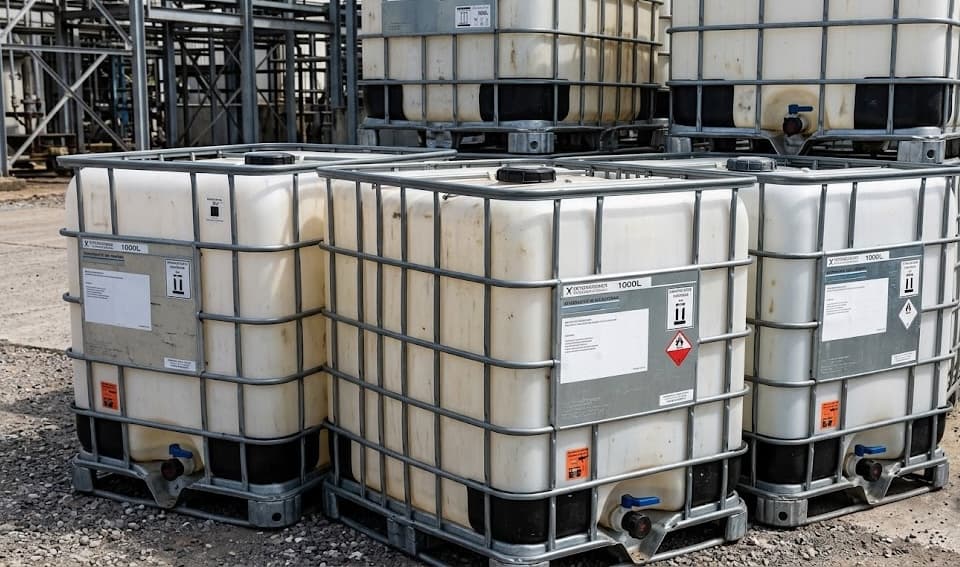
275 Gallon IBC Tote — Industry Standard
Full Specifications
The specifications below represent the most common 275-gallon IBC configuration. Exact values may vary slightly between manufacturers such as Schutz, Mauser (now MAUSER Packaging Solutions), Greif, and Snyder Industries.
Dimensional Drawing Reference
The table below provides every critical measurement for the 275-gallon IBC tote in both imperial (inches) and metric (mm) units. Use these values for CAD drawings, facility layout planning, racking configuration, and trailer load planning. Dimensions are measured to the outermost surface of the cage or pallet, not the bottle alone.
| Dimension | Inches | Millimeters |
|---|---|---|
| Overall Length (L) | 48.0 | 1,219 |
| Overall Width (W) | 40.0 | 1,016 |
| Overall Height (H) | 46.0 | 1,168 |
| Bottle Inside Length | 45.5 | 1,156 |
| Bottle Inside Width | 37.5 | 953 |
| Bottle Inside Height | 36.0 | 914 |
| Pallet Length | 48.0 | 1,219 |
| Pallet Width | 40.0 | 1,016 |
| Pallet Height | 5.5 | 140 |
| Fill Opening Diameter | 6.0 | 150 |
| Valve Outlet (NPS) | 2.0 | 50 |
| Cage Wire Spacing (H) | 3.0 | 76 |
| Cage Wire Spacing (V) | 5.0 | 127 |
| Fork Pocket Width | 7.5 | 191 |
| Fork Pocket Height | 3.5 | 89 |
| Center-to-Center Fork Spacing | 27.0 | 686 |
Filled Weight by Liquid Type
The total weight of a filled 275-gallon IBC depends on the specific gravity of the liquid inside. Use this table to determine forklift capacity requirements, floor load ratings, and trailer weight limits for your specific product. All weights include the ~118 lb empty tote weight.
| Liquid | Specific Gravity | lbs / gal | Filled (lbs) | Filled (kg) |
|---|---|---|---|---|
| Water | 1.00 | 8.34 | 2,412 | 1,094 |
| Diesel Fuel | 0.85 | 7.09 | 2,068 | 938 |
| Gasoline | 0.74 | 6.17 | 1,815 | 823 |
| Motor Oil (SAE 30) | 0.89 | 7.42 | 2,159 | 979 |
| Vegetable Oil | 0.92 | 7.67 | 2,227 | 1,010 |
| Glycerin | 1.26 | 10.51 | 3,008 | 1,364 |
| Sulfuric Acid (98%) | 1.84 | 15.35 | 4,339 | 1,968 |
| Hydrochloric Acid (37%) | 1.19 | 9.92 | 2,847 | 1,291 |
| Sodium Hydroxide (50%) | 1.52 | 12.68 | 3,605 | 1,635 |
| Ethanol | 0.79 | 6.59 | 1,930 | 876 |
| Isopropyl Alcohol | 0.79 | 6.59 | 1,930 | 876 |
| Antifreeze (Ethylene Glycol) | 1.11 | 9.26 | 2,664 | 1,208 |
HDPE Material Properties
High-Density Polyethylene (HDPE) is the universal material for IBC tote bottles because of its combination of chemical resistance, impact strength, and food-safe certification. The blow-molded HDPE bottle is the component that contacts your product, so understanding its properties is essential for compatibility decisions.
Steel Cage Specifications
The galvanized steel cage is what gives an IBC tote its structural integrity, stackability, and resistance to impact damage. Without the cage, the HDPE bottle would bulge, sag, and eventually rupture under the hydrostatic pressure of a full load. The cage transfers the weight of stacked totes through the corner verticals directly to the pallet, bypassing the bottle entirely.
Hot-dip galvanization provides a zinc coating that protects the underlying steel from corrosion for 10 to 20 years in typical outdoor conditions. The welded grid construction means there are no fasteners to loosen and no moving parts to fail. When a cage does eventually corrode beyond usefulness, the steel is 100% recyclable.
Pallet Options
The pallet is the foundation of every IBC tote. It determines compatibility with your material handling equipment, floor cleanliness requirements, and export shipping regulations. All pallet types share the same 48" x 40" footprint and provide 4-way forklift and pallet jack entry.
| Pallet Type | Weight | Load Capacity | Entry | Notes |
|---|---|---|---|---|
| Hardwood (Oak/Maple) | ~36 lbs (16 kg) | 5,500 lbs (2,495 kg) | 4-way | Most common, repairable, recyclable, ISPM-15 heat-treated for export |
| Treated Pine | ~30 lbs (14 kg) | 4,500 lbs (2,041 kg) | 4-way | Lighter, lower cost, fungicide-treated, adequate for domestic use |
| Steel | ~45 lbs (20 kg) | 8,000 lbs (3,629 kg) | 4-way | Longest lifespan, no rot or pest issues, welded to cage frame, heaviest |
| HDPE Composite | ~28 lbs (13 kg) | 5,000 lbs (2,268 kg) | 4-way | Wash-down compatible, FDA-friendly, no splinters, recyclable, most expensive |
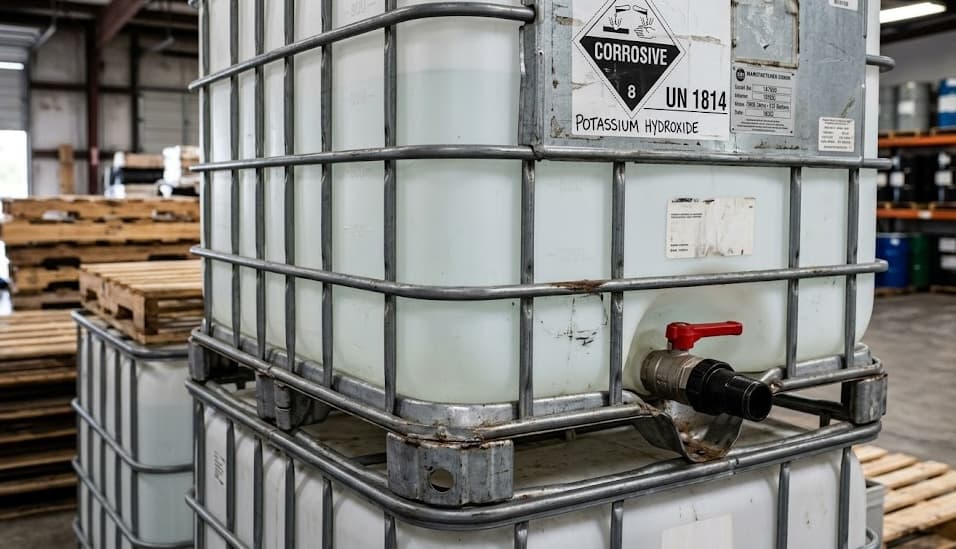
Built for Performance and Compliance
Every 275-gallon IBC tote features a 2-inch butterfly valve, UN/DOT certification markings, and a galvanized steel cage designed to withstand the rigors of industrial use. The valve, gasket, and lid are inspected or replaced during our reconditioning process to ensure leak-free operation from day one.
The UN label on each tote encodes its certification details, including packing group rating, maximum specific gravity, manufacture date, and facility code. Understanding these markings is essential for DOT-compliant hazardous material transport.
2" Butterfly Valve Specifications
The 2-inch butterfly valve is the standard discharge fitting on virtually all 275-gallon IBC totes manufactured worldwide. Its quarter-turn operation allows rapid opening and closing with one hand, even when wearing heavy gloves. The lever handle includes a detent lock at both the fully open (90 degrees) and fully closed (0 degrees) positions to prevent accidental actuation.
The polypropylene body is chemically resistant to the same range of products as the HDPE bottle, ensuring system-wide compatibility. The internal disc seats against an elastomeric gasket - EPDM for water, food products, and mild chemicals, or Viton (FKM) for aggressive solvents, fuels, and concentrated acids.
Under gravity discharge from a full 275-gallon tote (46 inches of head height), the 2-inch butterfly valve delivers approximately 25 GPM when fully open. A complete drain takes 15 to 20 minutes. For faster emptying, consider upgrading to a 2-inch ball valve or adding a pump.
UN Marking Decoder
Every UN-certified IBC tote has a marking stamped or embossed on the bottle and/or a metal plate riveted to the cage. This marking tells you everything about the container's certification: what it can carry, how much it can hold, when it was made, and who made it. A typical 275-gallon IBC marking reads something like:UN31HA1/Y/1.9/1500/05/24/USA/M-1234
Why UN Markings Matter
DOT (Department of Transportation) regulations require that any IBC used to transport hazardous materials on public roads must bear a valid UN marking that matches the contents being shipped. Using an IBC with an expired certification date, a specific gravity rating lower than the product inside, or a packing group designation that does not match the material is a federal violation subject to fines up to $75,000 per occurrence.
For non-hazardous storage applications (such as water, food products, or non-regulated chemicals), UN markings are not legally required but are still valuable as an indicator of manufacturing quality and structural testing. A tote that was built to UN standards will always be more reliable than one that was not, even if you are only using it to store rainwater.
15 Common Compatible Chemicals
HDPE is compatible with a wide range of chemicals. The table below covers the 15 most frequently stored chemicals in IBC totes at our facility. Always verify compatibility for your specific concentration and temperature conditions. We recommend a 30-day soak test with a sample coupon for any chemical not listed here.
| Chemical | Resistance | Notes |
|---|---|---|
| Acetic Acid (up to 50%) | Excellent | No swelling, no degradation at ambient temp |
| Sodium Hypochlorite (Bleach, 12.5%) | Good | Oxidizer - replace gaskets regularly; avoid prolonged UV |
| Phosphoric Acid (up to 85%) | Excellent | Standard for food-grade cleaning solutions |
| Sulfuric Acid (up to 70%) | Excellent | Use Viton gasket above 50% concentration |
| Hydrochloric Acid (up to 37%) | Good | Fuming above 30% - ensure vented cap |
| Sodium Hydroxide (up to 50%) | Excellent | No effect on HDPE even at elevated temp |
| Potassium Hydroxide (up to 45%) | Excellent | Common in soap/detergent manufacturing |
| Isopropyl Alcohol (100%) | Good | Minor swelling at elevated temps; OK at ambient |
| Ethanol (up to 95%) | Good | Use PTFE gasket for highest purity applications |
| Hydrogen Peroxide (up to 35%) | Good | Oxidizer - vented cap mandatory; Viton gasket |
| Citric Acid (saturated) | Excellent | Common food additive and cleaning agent |
| Urea Solution (DEF / AdBlue) | Excellent | 32.5% urea - must be food-grade tote |
| Glycerin / Glycerol | Excellent | High SG (1.26) - verify UN max gross weight |
| Liquid Fertilizer (10-34-0) | Excellent | Phosphoric acid base; standard ag use |
| Windshield Washer Fluid | Excellent | Methanol-based; low SG; no issues |
Storage Guidelines
Proper storage extends the useful life of your IBC tote, prevents product contamination, and keeps you in compliance with OSHA, EPA, and DOT regulations. Follow these guidelines for every tote in your facility, whether filled or empty.
Indoor Storage Temperature
50 F to 100 F (10 C to 38 C) for longest bottle life
Outdoor UV Protection
Cover with UV-resistant tarp or tote cover; HDPE degrades in direct sunlight within 12-18 months without protection
Surface / Foundation
Level concrete or compacted gravel; avoid soft ground that allows tilting
Stacking (Filled)
Maximum 2 high per UN/DOT; lower tote must have intact cage and pallet
Stacking (Empty)
Maximum 4 high when nested; secure with straps to prevent shifting
Clearance from Heat Sources
Minimum 36 inches from furnaces, boilers, steam lines, or radiant heaters
Fire Separation
Follow NFPA 30 for flammable liquids; 20 ft from buildings or fire-rated enclosure
Spill Containment
Required for hazardous materials per EPA 40 CFR 264.175; 110% of largest container volume
Inspection Frequency
Visual check weekly; detailed inspection every 90 days; replace gaskets annually
Shelf Life of HDPE Bottle
5 years from manufacture date per most UN certifications; rebottle after expiration
Stacking Load Tables
Stacking IBC totes is one of their key advantages over drums and rigid tanks. However, the total weight must be within the structural limits of the bottom tote's cage, pallet, and the floor beneath it. Use this table to plan stacking configurations for different liquid densities.
| Configuration | Total Weight | Bottom Pallet Load | Notes |
|---|---|---|---|
| Single tote (filled with water) | 2,412 lbs | 2,412 lbs | Within standard pallet jack capacity |
| 2-high stack (both filled, water) | 4,824 lbs | 4,824 lbs | Requires forklift; verify floor load rating |
| Single tote (SG 1.5 liquid) | 3,554 lbs | 3,554 lbs | Exceeds most pallet jack capacity |
| 2-high stack (SG 1.5 liquid) | 7,108 lbs | 7,108 lbs | Verify cage and pallet rating; UN cert required |
| Single tote (SG 1.9 liquid) | 4,477 lbs | 4,477 lbs | Maximum UN-rated SG; forklift only |
| 2-high stack (SG 1.9 liquid) | 8,954 lbs | 8,954 lbs | Rarely practical; consult structural engineer for floor |
Maintenance Tips
A well-maintained IBC tote can last 5 to 7 years in active service before it needs rebottling. Neglected totes fail early, usually from a preventable gasket leak, UV-degraded bottle, or seized valve. These maintenance practices will maximize the service life of every tote in your inventory.
Valve
Operate the butterfly valve through a full open-close cycle monthly to prevent the disc from seizing. Replace the EPDM gasket every 12 months or immediately if dripping. Lubricate the shaft with food-grade silicone grease annually.
Lid / Fill Cap
Inspect the lid gasket for cracks or compression set every 6 months. Replace vented caps if the vent membrane is clogged or torn. Torque the lid to hand-tight plus a quarter turn - do not over-tighten or the gasket will extrude.
HDPE Bottle
Check for hairline cracks, especially at the corners and around the valve boss. UV-damaged bottles become chalky white and brittle. If you can scratch the surface with a fingernail, the bottle has degraded and should be replaced or the tote retired.
Steel Cage
Inspect welds at the top frame and corner verticals. Surface rust on galvanized cage is cosmetic and does not affect strength. Deep rust or broken wires at more than two locations means the cage should be replaced.
Pallet
Wood pallets should be checked for split boards, protruding nails, and rot. A single broken board on a wood pallet reduces load capacity by approximately 15%. Steel and composite pallets should be checked for bends and cracks at fork entry points.
Labels & Markings
Remove old labels before refilling. Residual labels can obscure UN markings and lead to compliance issues during DOT inspections. Use a heat gun and plastic scraper; avoid sharp metal scrapers that can gouge the bottle.
Cleaning
Triple-rinse with the final product or a compatible solvent. For food-grade service, use hot (160 F) potable water with a CIP (clean-in-place) detergent followed by a sanitizing rinse. Allow to dry with the lid open to prevent mold growth.
Gasket Inventory
Keep a stock of replacement valve gaskets, lid gaskets, and camlock gaskets on hand. A single leaking gasket can drain an entire tote. Gaskets are inexpensive insurance against product loss and environmental incidents.
Available Grades
We stock 275-gallon IBC totes in three condition grades plus a rebottled option. Each tote passes our 12-point inspection before being assigned a grade.
Rebottled
- Brand-new HDPE bottle
- Reconditioned cage and pallet
- Suitable for food-grade use
- Best option for sensitive materials
- Pressure-tested before sale
Grade A
- One-trip or lightly used
- No staining or damage
- Cage in excellent condition
- Ideal for food-grade if sourced from food supply chain
- Our most popular grade
Grade B
- Used 2-3 times, light wear
- Minor scuffing or label residue
- Fully functional
- Great for chemicals and industrial use
- Best value for most buyers
Grade C
- Multiple uses, visible wear
- Cosmetic imperfections
- Structurally sound
- Best for non-sensitive storage
- Lowest cost per unit
Common Applications
The 275-gallon IBC tote is the most versatile bulk liquid container in commercial use today. Here are the industries and applications we serve most frequently.
Chemical Storage & Transport
The 275-gallon IBC is the most widely used container for non-hazardous and mildly hazardous chemicals. Its UN31HA1/Y rating certifies it for the transport of liquids with a specific gravity up to 1.9, covering a broad range of industrial chemicals, cleaning agents, and solvents. The HDPE bottle provides excellent chemical resistance to most acids, bases, and aqueous solutions.
Food & Beverage Processing
Food-grade 275-gallon totes are used throughout the food industry for storing and transporting juice concentrates, edible oils, liquid sweeteners, vinegar, wine, and potable water. Our food-grade units are either rebottled with a brand-new HDPE bottle or sourced from verified food-product supply chains with full documentation of prior contents.
Agriculture & Irrigation
Farmers and growers rely on 275-gallon IBCs for liquid fertilizer storage, pesticide mixing, water transport to remote fields, and drip irrigation supply tanks. The standard pallet base allows the tote to be loaded onto a truck bed or trailer with a forklift, and the 2" butterfly valve connects directly to irrigation hose assemblies.
Manufacturing & Industrial
Production lines use 275-gallon IBCs as process feed tanks, waste collection vessels, coolant reservoirs, and raw material holding containers. The 48" x 40" footprint matches the standard North American pallet, making the 275-gallon IBC compatible with virtually all existing racking, conveyors, and warehouse systems.
Pharmaceutical & Cosmetic
Pharmaceutical manufacturers and cosmetic formulators use dedicated food-grade or rebottled 275-gallon totes for excipients, purified water, glycerin, and fragrance bases. Strict cleanliness and traceability requirements make rebottled totes the preferred option in these industries.
Water Storage & Emergency Prep
For residential, commercial, and municipal emergency preparedness, the 275-gallon IBC provides a compact, stackable water reserve. A single tote holds enough potable water for a family of four for more than a month. Multiple totes can be manifolded together for fire suppression reserves or disaster relief staging.
275 Gallon vs 330 Gallon: Full Comparison
Choosing between the 275-gallon and 330-gallon IBC tote depends on your specific requirements for height clearance, weight limits, stacking needs, and cost-per-gallon targets. This side-by-side comparison covers every major differentiator.
| Specification | 275 Gallon | 330 Gallon |
|---|---|---|
| Nominal Volume | 275 gal (1,041 L) | 330 gal (1,249 L) |
| Overflow Capacity | ~284 gal (1,075 L) | ~340 gal (1,287 L) |
| Length | 48 in | 48 in |
| Width | 40 in | 40 in |
| Height | 46 in | 53 in |
| Empty Weight | ~118 lbs | ~145 lbs |
| Filled Weight (Water) | ~2,410 lbs | ~2,890 lbs |
| Bottle Wall Thickness | 2.0 - 3.0 mm | 2.5 - 3.5 mm |
| Cage Wire Diameter | 4.0 - 5.0 mm | 4.5 - 5.5 mm |
| Pallet Footprint | 48 x 40 in | 48 x 40 in |
| 2-High Stacking in Trailer | Yes (92 in total) | No (106 in exceeds 102 in trailer) |
| Pallet Jack Friendly (filled) | Yes (under 2,500 lbs) | No (exceeds 2,500 lbs) |
| Cost per Gallon of Capacity | Higher | 5 - 10% Lower |
| Drain Time (gravity, 2" valve) | ~15 - 20 min | ~20 - 25 min |
| Warehouse Racking Fit (48" beam) | Yes | Requires 54"+ beam spacing |
When to Choose 275 Gallon
- Your facility has racking with 48-inch beam spacing that cannot be adjusted
- You need to double-stack totes in standard 102-inch trailers for freight efficiency
- Filled totes will be moved with manual pallet jacks rated at 2,500 lbs
- Your process consumes less than 275 gallons between changeovers
- You are storing liquids with specific gravity above 1.5 (weight becomes limiting)
- Floor load capacity in your building is borderline for heavier loads
When to Choose 330 Gallon
- You want 20% more capacity without using more floor space
- Your facility has forklifts capable of handling 3,000+ lb loads
- You ship single-stacked totes and height clearance is not a concern
- Reducing container changeover frequency is a priority for production uptime
- Your racking has adjustable beam heights of 54 inches or more
- Lower cost per gallon of container capacity is the primary purchasing driver
Ordering Information
We keep hundreds of 275-gallon totes in stock at our Elk Grove Village facility at all times. Whether you need a single tote for a backyard project or a full truckload for your production line, we can accommodate your order with fast turnaround.
Request a Quote
Call us at (773) 800-2280 or submit a request through our contact form. Let us know the quantity, grade, and any special requirements (food-grade, specific prior contents, pallet type).
Review & Confirm
We will send you a quote with pricing, availability, and estimated delivery date within 2 hours during business hours. Volume discounts are applied automatically for orders of 10 or more.
Pickup or Delivery
Pick up at our warehouse at 2645 American Ln, Elk Grove Village, IL 60007 for free. Local delivery available throughout Chicagoland. Nationwide shipping via common carrier for any quantity.
Ongoing Support
We provide replacement valves, gaskets, and accessories for every tote we sell. When your totes reach end of life, we will buy them back through our recycling program.
Volume Pricing Tiers
Shipping Details
- Standard 53-foot trailer holds 56 single-stacked or 40 double-stacked 275-gal totes
- LTL shipping available for 1 to 10 totes
- Flatbed recommended for loads over 10 totes to avoid height issues
- Same-day dispatch for orders placed before 2 PM Central
- Freight collect or prepaid options available
- Local Chicagoland delivery with our own trucks for 1-20 totes
Ready to Order 275 Gallon IBC Totes?
We keep hundreds of 275-gallon totes in stock at our Elk Grove Village facility. Single units to full truckloads, we can ship within 24 to 48 hours of your order.